
Why we grow things we could just buy
Echinops Blue
And why imperfection is actually the point
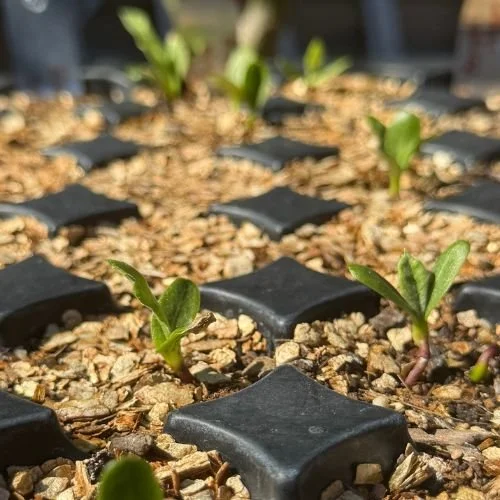
Planting seeds this morning. Magpies chortling. Bonnie wanting me to throw her ball over and over. Mug of tea steaming away on the bench. And I was thinking - in my grandparents’ generation wanting to speak to a loved one in another town required pen, paper and days between posting your questions and getting their reply. In my mother’s youth, a trip to the UK meant 6 weeks on a boat. Peaches were only available in summer. Now we live an age of almost magical abundance, speed and convenience.
And why, when you can order almost anything – anything - online with a click and have it arrive at your door the next day, would you commit to spending months growing flowers from seed?
And yet. Here I am, putting seeds in soil and waiting.
It makes absolutely no rational sense. And the more I think about it the more I think that’s exactly why we love it.
The joy of growing something is inseparable from the limits of it. There is only so much you can do. You cannot hustle a seed. You cannot optimise it. You provide the conditions, you tend it, and then — at some point — you have to let go. I can’t control the weather, the wind, or the husband who forgets to water whilst I am away with work. Yet one morning, I come out with my mug of tea and there she is, popping through the soil. She has decided to turn up.
The satisfaction of that is astronomical. Disproportionate, even.
And here’s the other thing I’ve been thinking. What grows will not be perfect.
It will be a little lopsided, or shorter (or taller), or bushier (or lankier), or not quite the colour I was expecting. It will bloom two weeks later or earlier than expected in the most inconvenient yet delightful way. Home grown flowers have the quality perhaps of hand-stitched shoes — not mass produced, not even the same as the last pair, but with the hand of the maker clearly visible. The wearer and the maker connected by the object.
When you grow your own flowers, you can feel the difference in the very spirit of them. They will be imperfect in same way that a jazz musician playing your favourite song is imperfect — the notes bent slightly, something alive in it that the original recording doesn’t have. What you grew has that same quality. And it is entirely, unmistakably yours.
In a world that seeks to optimise everything — our productivity, our finances, our sleep, our nutrition — growing flowers is a tiny rebellion. A deliberate choosing of the slow, uncertain, beautiful thing.